PyCRobo systems are built on a shared technology foundation: machines that learn by observing, perceive in real time, and act with awareness. This foundation rests on three core pillars.
1. Imitation and Deep Imitation learning
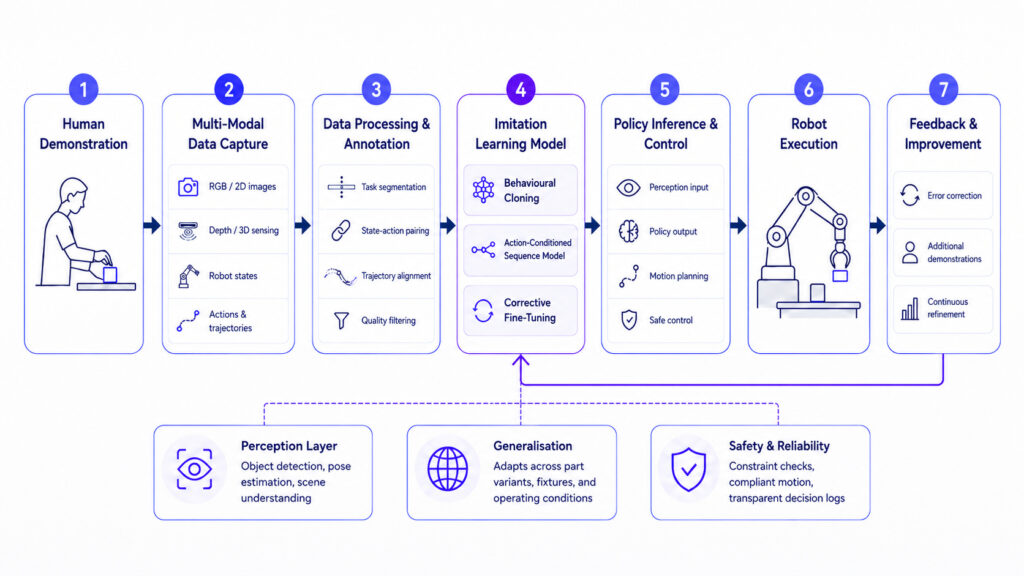
Operators demonstrate, and the robot learns. Our policy-learning stack integrates behavioural cloning, action-conditioned sequence models, and corrective fine-tuning to reproduce complex manipulation tasks, achieving approximately 89% task success rate on internal benchmarks without scripted programming or task-specific re-engineering.
2. Image Processing and Computer Vision
Our vision system blends 2D images, 3D depth maps, and light scanning to create a complete view of the scene. It can spot objects, estimate their position, and understand their shape in real time.
3. Edge Inference, Machine and Deep learning
We use advanced AI models to recognise patterns in movement and appearance. These models keep getting better as we add more data and retrain them.
Architecture Principles
- Modular: New tasks, sensor types, and deployment sites can be added without re-platforming.
- Safety-rated: Motion and compliance control with transparent decision logs for auditable operations.
- Real-world tested: Validated under variable lighting, vibration, contamination, and cycle-time constraints.
- Edge-native: Deterministic inference on-premises.
Ready to explore adaptive automation?